
Generative AI and Youth Learning Across the Globe
One major concern people have is the possibility that AI might take away the “productive struggle” necessary for learning. There is a fear that youth may miss out on opportunities to develop the foundational skills and knowledge they need to thrive academically. Yet, one often overlooked point in this narrative is the assumption that AI created this problem. In reality, factors like motivation, readiness, and self-regulation have always played a role in learning–even before AI entered the picture. To truly understand AI’s impact, we need to look deeper into the factors that shape the ways AI is used and the consequences these patterns have on learning.
In this series of studies, we set out to explore this through a two-pronged approach: first, by describing the phenomenon—how adolescents are using AI in their learning processes; and second, by understanding the antecedents—the individual, social, and contextual factors that shape how and why students choose to engage with AI in the first place.
Ongoing Studies
Large scale surveys to understand the landscape
We collaborated on the design of a large-scale survey, which was distributed by ministries of education and language centers in Mexico, Colombia, and Panama. The survey includes both structured and open-ended questions, capturing students’ access to AI, frequency and purpose of use, emotional responses, and reflections on how AI affects their self-perception and academic identity. Below are the full reports:
Several highlights:
-
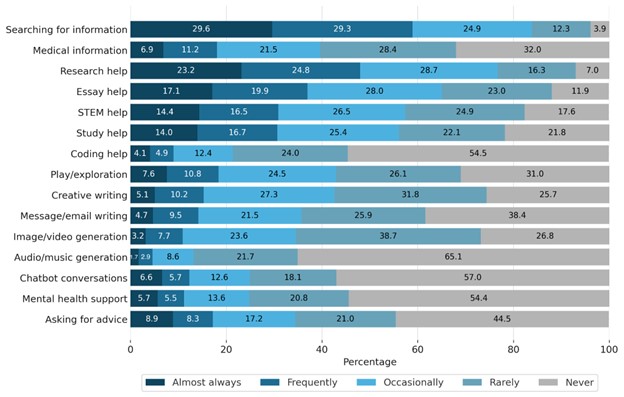
How often and in what ways students use AI tools—for outlining essays, solving math problems, studying for tests, and more?
-
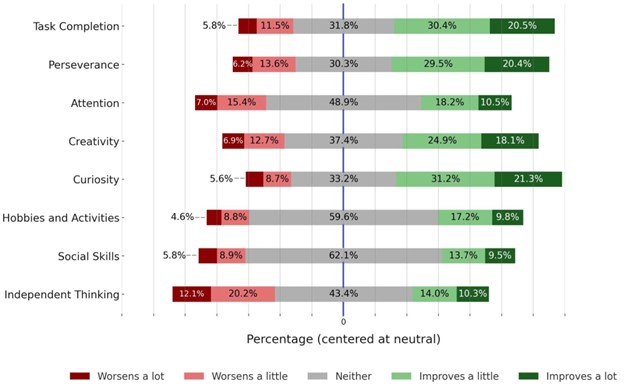
How AI use influences students’ beliefs about their own academic abilities and performance?
-
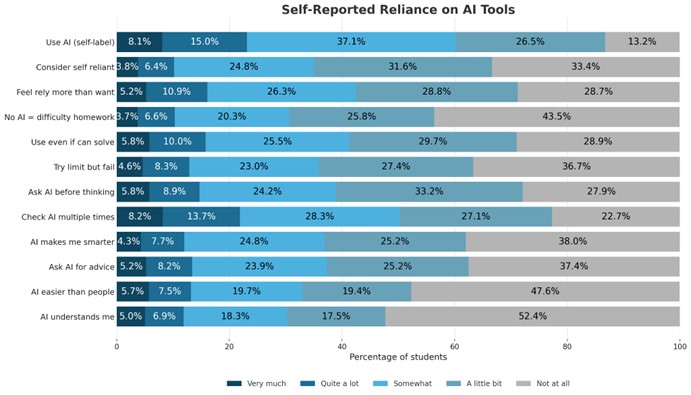
Patterns of dependency or trust in AI, including concerns about overreliance.
-
Students’ own reflections on how AI is changing the way they learn, study, and think about school
AI’s impact on academic performance
In this study, we aim to uncover causal links between AI usage and academic performance—questions that were difficult to address through the surveys above. We seek to understand a set of factors, including motivation, beliefs, academic readiness, self-regulation, and AI literacy, that may influence whether youth engage with AI as a means of outsourcing or as an additional resource for deeper learning. We have been collaborating with high school students, educators, and district leaders to co-design the study and generate evidence that may support your decision-making. Contact us if you would like to be part of it!
Social dynamics surrounding AI usage disclosure
With the rise of AI tools being used in academic settings, the notion of academic integrity is becoming more complex in schools. Teachers are at the forefront of reimagining what academic integrity means when students can use AI tools to complete tasks, augment their work, and aid them in their learning. One approach to maintaining academic integrity is to require students who use AI on their assignments to disclose that use and specify the nature of the assistance. This expectation has been written into many AI policies at both the district and school levels. This project seeks to examine this policy and support teachers in reflecting on what academic integrity means in the context of AI integration by investigating the practice of AI usage disclaimers. To do so, we aim to better understand how teachers perceive AI tools and students’ use of them, as well as the factors that shape those perceptions and potential biases.